
Perfectionism rarely looks like fear from the outside. It looks like high standards, a strong work ethic, caring a lot. But underneath the polish, it's usually a quiet worry that if something isn't flawless, it says something bad about you. That's why it's so exhausting: you're not just doing the task, you're defending your worth with every detail.
The good news is that you don't have to lower your standards to feel better. You only need a clearer line between excellent and enough, and a few simple tools that help you stop at that line without the guilt. It took me a long time to understand that "good enough" isn't settling. Most of the time, it's simply finished.
This guide explains what perfectionism really is, how it differs from healthy striving, the signs that it's running your days, where it often comes from and ten practical tools to let good enough be enough. You'll also find a "good enough" definition card you can fill in before any task, plus a few kind scripts for the moments when your inner critic gets loud.
Be gentle with yourself as you read. You don't have to fix this perfectly either.
What Perfectionism Really Is

Perfectionism is the belief that anything less than flawless isn't acceptable, and that mistakes or imperfections reflect on who you are, not just on what you did. It's less about loving quality and more about avoiding a feeling: embarrassment, criticism, disappointing someone, being "found out."
That's why I like to describe it as fear dressed as high standards. The standards look admirable, and sometimes they produce beautiful work. But the engine underneath is anxiety, and anxiety never says "this is enough." It always finds one more thing to fix.
Perfectionism also tends to be selective. You might be relaxed about your car but impossible to satisfy about your work emails. Or easygoing at work but hard on yourself about how your home looks when friends visit. Wherever it shows up, it follows the same pattern: a fixed picture of how things should be, and a sense of threat when reality doesn't match.
Healthy Striving vs Perfectionism
Wanting to do well is lovely. It's how skills grow and how good work gets made. The difference lies in what drives you and how you feel along the way:
- Healthy striving is pulled by a goal. Perfectionism is pushed by fear.
- Healthy striving sets high but reachable standards. Perfectionism sets standards that move every time you get close.
- Healthy striving treats mistakes as information. Perfectionism treats mistakes as proof that you're not good enough.
- Healthy striving can enjoy the process. Perfectionism only feels relief, briefly, at the end.
- Healthy striving knows when to stop. Perfectionism keeps editing long after the improvements stop mattering.
- Healthy striving can take feedback. Perfectionism hears feedback as a verdict.
Most of us live somewhere in between, sliding toward perfectionism when we're tired, stressed or feel watched. That's normal. The goal is to notice the slide early.
8 Signs Perfectionism Is Running Your Days
You don't need to relate to all of these. Even two or three can quietly drain your time and energy:
- You procrastinate until conditions are perfect. If you can't do it brilliantly, it feels safer not to start, so the task waits for the "right" mood, day or amount of time.
- You think in all-or-nothing terms. A workout that's 20 minutes instead of 45 feels pointless, so you skip it entirely.
- You edit endlessly. A two-line message gets rewritten five times. A project is "almost ready" for weeks.
- Your self-talk is harsh. You'd never speak to a friend the way you speak to yourself after a small mistake.
- You fear feedback. You avoid sharing work, or you brace yourself so hard that even kind feedback stings.
- You struggle to delegate. Nobody else will do it "right," so you do everything yourself and feel overwhelmed.
- Your wins don't land. You finish something good and immediately notice what could have been better.
- Rest feels earned, never given. You can only relax once everything is done, and everything is never done.
If number one feels painfully familiar, you might also find my guide on how to stop procrastinating helpful, because the two habits feed each other more than most people realize.
Where Perfectionism Often Comes From
Nobody chooses perfectionism. It usually grows from something that once made sense, and understanding that can soften the shame around it. A few common roots:
- Being praised mainly for achievements. If love or attention seemed to arrive with good grades or "being so good," it's natural to learn that performance equals worth.
- Unpredictable or critical environments. Getting everything right can feel like the only way to stay safe or keep the peace.
- Being the "capable one." When people rely on you, there's pressure never to drop the ball.
- Anxiety. Perfectionism can work as a way of controlling uncertainty. If every detail is handled, maybe nothing bad will happen.
- Constant comparison. Seeing other people's highlight reels makes ordinary, good work look like failure.
I'm prone to anxiety myself, and I've noticed my perfectionism gets louder on anxious days. That's useful to know. When I catch myself rewriting the same sentence for the fourth time, it's usually not the sentence that needs attention. It's my nervous system.
Perfectionism also overlaps with the feeling of being a fraud, so if you often worry you'll be "found out," my guide to imposter syndrome may feel like it was written for you.
How To Let Good Enough Be Enough: 10 Practical Tools
These tools work best in small doses. Pick two to try this week, notice what happens and add more later. Trying to master all ten at once would be a very perfectionist move.
1. Define "Done" Before You Start

Perfectionism thrives on vague finish lines. "Clean the kitchen" can stretch into scrubbing grout at midnight. "Write the report" can last a month.
Before you start any task, write one sentence that describes what finished looks like: "Done = counters wiped, dishes away, floor swept." "Done = report covers the three main points and has been spell-checked once." When you hit that sentence, you stop. Anything extra is a choice, not an obligation.
A pastel desk notepad next to your laptop makes this easy. One sheet, one task, one definition of done.
2. Use the 80% Rule
In most tasks, the first 80% of the quality comes from a reasonable amount of effort. The last 20% can take as long again, and often nobody else notices it.
Before you polish something further, ask: "Would anyone besides me notice this improvement? Would it change the outcome?" If the honest answer is no, you're at 80%, and 80% is a perfectly good place to stop for emails, presentations for internal meetings, home projects, social media posts and most everyday tasks. Save your 100% for the few things that truly deserve it.
A helpful way to sort this: make a short list of the three or four areas where excellence genuinely matters to you right now. Maybe it's one big project, your health and a close friendship. Everything outside that list gets the 80% treatment by default. It feels uncomfortable for a week or two, and then it feels like breathing room, because you suddenly have energy left for the things you actually care about.
3. Time-Box Your Tasks

A time box is a fixed amount of time you give a task, after which you stop and send, submit or move on. It turns "until it's perfect" into "until 3:30."
- Emails: 5 minutes each, then send.
- A first draft: 45 minutes, no editing allowed.
- Tidying a room: 20 minutes, then done.
- Choosing an outfit: 10 minutes, then wear it.
A gold sand timer on your desk works beautifully for this, because watching the sand fall feels calmer than a phone alarm, and there's no screen to pull you into something else. If you want to plan whole days this way, my guide to time blocking for beginners builds on the same idea.
4. Run Small "Good Enough" Experiments
Perfectionism makes predictions: "If I send this with a typo, people will think I'm careless." The only way to test those predictions is to gently break the rule and see what actually happens.
Try one small experiment a week:
- Send an email after reading it only once.
- Leave one small thing at home slightly undone when friends visit.
- Post a photo without editing it.
- Bring a store-bought dessert to a gathering instead of an elaborate homemade one.
- Do a 10-minute workout instead of skipping because you don't have 45.
Afterwards, write one line in your journal: what you feared, and what really happened. Over time, those lines become evidence your nervous system can trust.
5. Notice and Rewrite Your Self-Talk
Perfectionist self-talk tends to use absolute words: always, never, ruined, should, terrible. The first step is simply catching them. The second is rewriting the sentence the way a fair, kind friend would.
- "I always mess things up." → "I made one mistake in a mostly good piece of work."
- "This is terrible." → "This isn't my favorite version, and it's still useful."
- "I should have done more." → "I did what I could with the time and energy I had."
You don't have to believe the new sentence fully at first. You just have to say it often enough that it becomes an option.
6. Keep a Self-Compassion Script Ready

When you've made a mistake, the inner critic speaks fast. A short script helps you respond before the spiral starts. Here's one I like, built on three simple parts:
"This is hard right now. Everyone makes mistakes, it's part of being human. What would help me most in this moment?"
Write it on the first page of a linen journal or in your phone notes. Say it slowly, ideally with a hand on your chest. It sounds simple, and it is, but it interrupts the habit of punishing yourself. My full guide to self-compassion has more scripts and exercises if this one resonates.
Evenings are often when the critic replays the day, so I like pairing this with a quiet ritual: a soft candle in a glass jar, a cup of tea and five minutes with the journal before bed.
7. Handle Mistakes With a Three-Step Reset
When something genuinely goes wrong, perfectionism wants you to either hide it or replay it for days. Neither helps. Try this instead:
- Name it plainly: "I sent the file without the attachment."
- Repair what you can: "Sorry, here it is!" No long apology, no self-criticism in the message.
- Take one lesson and let the rest go: "Next time I'll attach first, then write." Then close the loop on purpose and move on to the next task.
Most mistakes are smaller to other people than they feel to you. People remember how you handled something far more than the slip itself.
8. Let Others See Unfinished Work
This one feels scary, which is exactly why it helps. Share a rough draft with a trusted colleague. Show a friend a half-finished project. Ask for input at 60% instead of presenting at 100%.
Two things usually happen. First, the feedback arrives early, when it's easy to use. Second, you discover that people don't think less of you for showing the messy middle. Often they feel closer to you, because they recognize their own process in yours.
If you tend to polish things to avoid anyone being disappointed, there's a strong link to people pleasing too. My guide on how to stop people pleasing covers that side of it.
9. Separate Your Worth From Your Output
Perfectionism quietly merges two questions: "Is this work good?" and "Am I good?" Pull them apart on purpose.
A small daily habit: at the end of the day, write down one thing you did and one quality you showed that has nothing to do with results. "I finished the presentation" and "I was patient with my sister on the phone." Over time, your sense of self grows wider than your to-do list, and mistakes stop feeling like they define you.
It also helps to remember how you see the people you love. You don't value your best friend because her emails are flawless or her kitchen is spotless. You value her for her humor, her loyalty, the way she checks in. You deserve to be seen through the same lens, and that includes being seen that way by yourself.
10. Celebrate Finished, Not Flawless
Perfectionists rarely celebrate, because there's always something that could have been better. Change the rule: you celebrate when something is finished, not when it's flawless.
Keep the celebrations small and real. Tick it off in an undated planner in soft blush, take a slow walk, make a nice cup of tea, tell someone you finished. Your brain learns from what gets rewarded, and right now it might only be rewarded by relief. Give it something kinder.
The Good Enough Definition Card
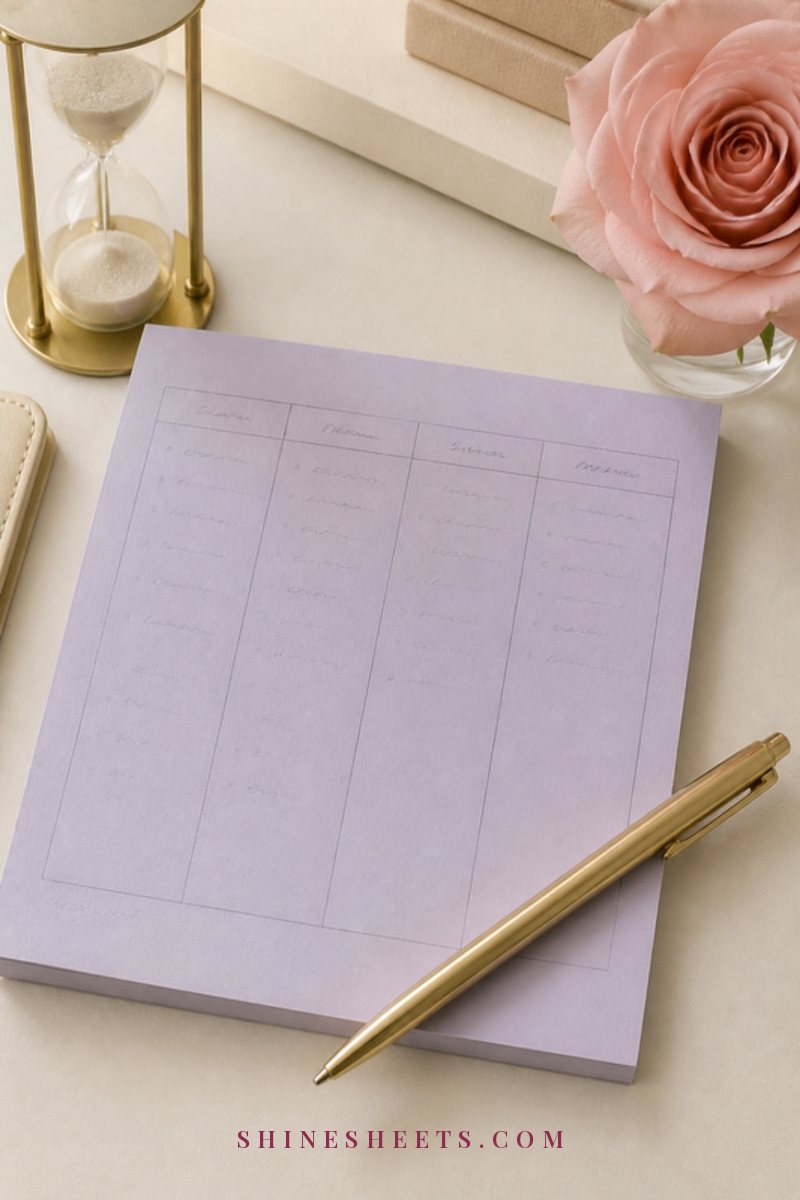
This is the heart of this guide. Before any task that tends to spiral, fill in four lines: the task, what the perfect version would look like, what the good-enough version looks like and how much time you'll give it. Seeing the two versions side by side is surprisingly calming, because the good-enough version almost always looks completely fine.
Here are a few examples to show how it works. Screenshot the format and make your own on a notepad.
| Task | Perfect version | Good-enough version | Time limit |
|---|---|---|---|
| Work email to a client | Rewritten five times, every word weighed | Clear, polite, one read-through for typos | 10 minutes |
| Hosting friends | Spotless home, homemade everything, styled table | Tidy main room, clean bathroom, simple snacks | 1 hour of prep |
| Weekly workout | Five 1-hour sessions, perfect form | Three 20-minute sessions you enjoy | 1 hour total |
| Presentation slides | Custom design, every slide perfect | Clean, readable slides with the key points | 2 hours |
| Birthday card | The perfect, heartfelt paragraph | Three warm, honest sentences | 10 minutes |
| Weekend tidy | Every drawer organized | Surfaces clear, laundry done | 45 minutes |
The time limit matters as much as the description. When the time is up, the good-enough version is the finished version.
Gentle Daily Habits That Quiet Perfectionism
Beyond the tools above, a few daily habits make the whole pattern softer over time:
- Limit your top priorities to three a day. Perfectionists often plan for a version of themselves with unlimited energy.
- Leave white space in your schedule. Tasks take longer than planned, and that's not a failure.
- Reduce comparison inputs. Mute accounts that leave you feeling behind.
- Read a few words of perspective. Sometimes one sentence reframes a whole day. My collection of perfectionism quotes is a nice place to start.
- Rest before you're finished. Practice taking a break while things are still undone. It feels strange at first, then freeing.
When Perfectionism Feels Bigger Than You
For some people, perfectionism is a mild habit. For others, it's tied up with anxiety, low mood, burnout or obsessive thoughts, and it takes up much more of life than any article can address.
If your standards are leaving you exhausted, unable to finish things, avoiding important parts of your life or feeling worthless after mistakes, please consider talking to a therapist or your doctor. Approaches like cognitive behavioral therapy work very well for perfectionism, and asking for help is not a sign that you've failed at helping yourself. It's a very wise next step.
Final Thoughts
Perfectionism promises safety, but it mostly delivers exhaustion. Letting good enough be enough doesn't mean you stop caring. It means you choose where your care goes, and you let yourself finish, rest and be human in between.
Start with one small experiment this week: define done, set a time limit and stop when you get there. Each time you do, you're teaching yourself that you were always more than the details.