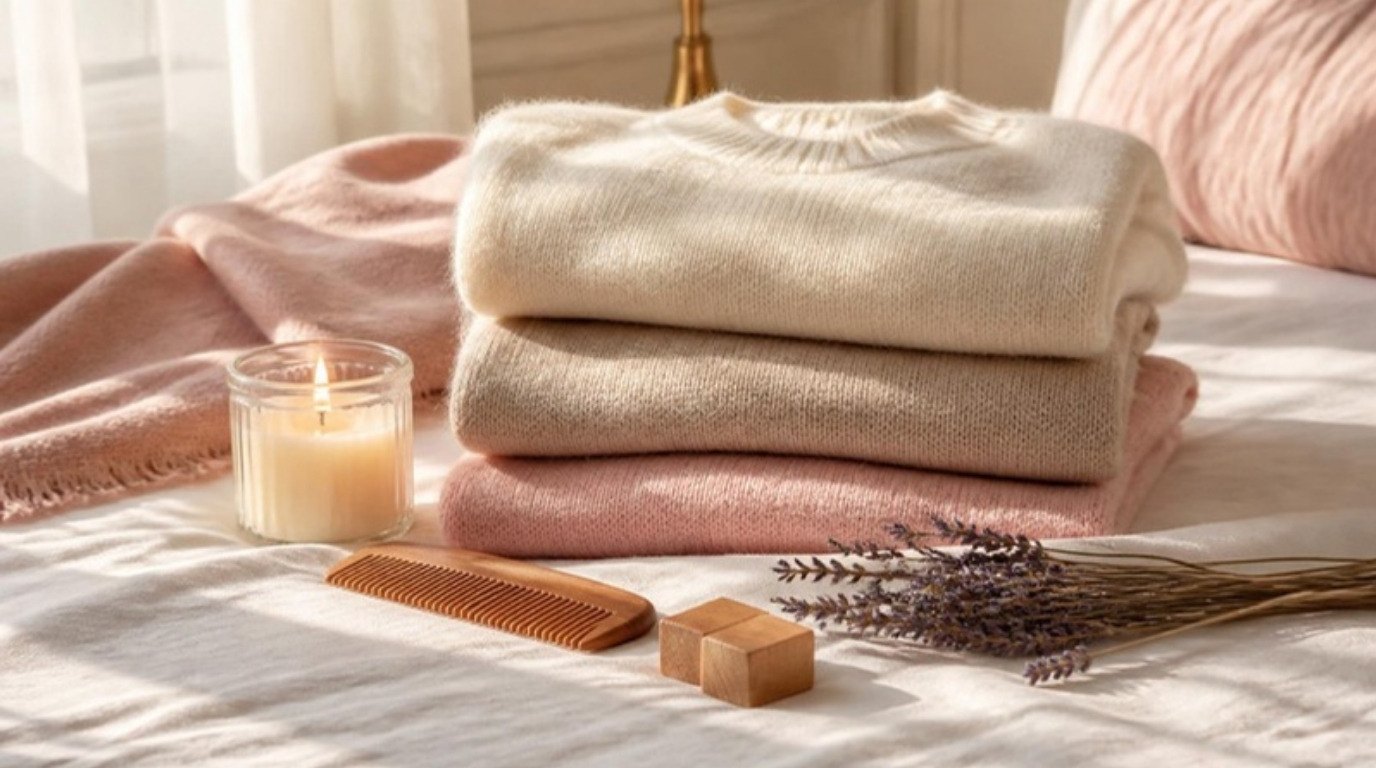
A good cashmere or wool sweater doesn't wear out from being worn. It wears out from being washed too hot, dried on a hanger and folded away with last week's body lotion still in the fibers. The fiber itself is surprisingly tough – sheep and goats live in it through storms and snow – it just asks for a gentler routine than the rest of your laundry.
The good news is that this routine is short. Cool water, the right soap, no wringing, a flat surface to dry on and a clean, breathable place to rest between seasons. Once those few habits are in place, a sweater you love can stay soft, shapely and pill-free for years instead of one winter.
This guide covers how to care for cashmere and wool sweaters from start to finish: how often to wash, a step-by-step hand wash, when the machine wool cycle is fine, how to dry, depill, store and protect your knits from moths, plus fixes for wrinkles, stretched cuffs and packing. There's also a sweater care cheat sheet by fiber – cashmere, merino, lambswool, mohair and blends – that you can screenshot for laundry day.
It took me a while to accept that the softest sweaters need the least effort, not the most. Less scrubbing, less heat, less fuss. Let's start with the question everyone gets wrong.
How Often Should You Wash Cashmere and Wool?
Much less often than you think. Wool and cashmere are naturally odor-resistant and don't hold onto smells the way cotton or synthetics do. Overwashing is one of the main reasons sweaters lose their softness, shrink slightly or start to look tired.
Here's a simple rule of thumb:
- Worn over a layer (a tee, cami or shirt): wash every 5–8 wears, or two to three times per season.
- Worn directly on skin: wash every 2–4 wears, especially at the underarms and neckline.
- After a spill, sweat or a smoky room: spot clean right away or wash soon – stains set and moths love them.
- Before storing for the season: always wash, even if it looks clean. Invisible traces of skin oils and food are exactly what moth larvae feed on.
Between wears, give your sweater a day off. Lay it flat or drape it over a chair back overnight so it can air out and the fibers can relax back into shape. Wearing the same knit three days in a row is harder on it than any wash.
How To Hand Wash Cashmere and Wool Sweaters: 7 Steps
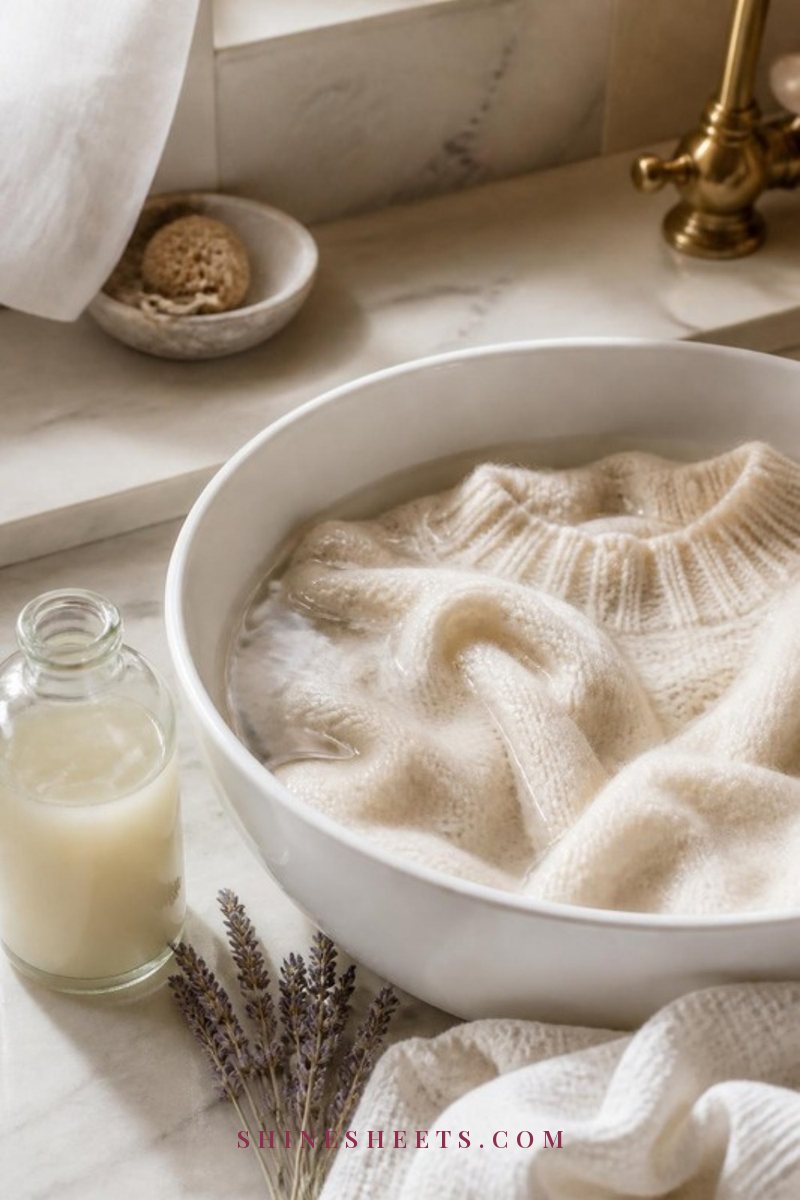
Hand washing is the safest method for anything you love, and it takes about 20 minutes of mostly waiting. Here's exactly how I'd do it.
1. Check the Label and Turn It Inside Out
Look for the fiber content and any "dry clean only" note. Many "dry clean only" cashmere and lambswool pieces hand wash beautifully, but structured pieces (lined cardigans, anything with leather trims or heavy embellishment) are better left to a professional. Turn the sweater inside out to protect the outer surface from friction, and close any buttons.
2. Fill a Basin With Cool Water
Use a clean sink, basin or bathtub and cool to lukewarm water – around 30°C/85°F at most. If it feels warm on your wrist, it's too warm. Hot water plus movement is what causes felting and shrinking, and once wool felts, it doesn't go back.
3. Add a Gentle Wool Wash
Add a capful of a gentle wool and cashmere wash and swish it through before the sweater goes in. Look for a pH-neutral, enzyme-free formula – enzymes in regular detergent are designed to break down protein stains, and wool and cashmere are made of protein. A mild baby shampoo works in a pinch. Skip fabric softener completely; it coats the fibers and dulls that natural softness.
4. Soak, Don't Scrub
Submerge the sweater, gently press it down so it's fully soaked, then leave it for 10–15 minutes. That's it. No rubbing, no twisting. For a spot at the cuffs or neckline, press the area softly between your fingertips a few times while it soaks.
5. Rinse in the Same Temperature
Drain the basin, refill with cool water at the same temperature (sudden changes from warm to cold can shock the fibers), and press the sweater gently to release the soap. Repeat once or twice until the water runs clear. Some wool washes are no-rinse – in that case, simply drain and move on.
6. Press Out the Water – Never Wring
Lift the sweater out in a bundle, supporting the whole weight with both hands so it doesn't stretch. Press it against the side of the basin to squeeze out excess water. Wringing or twisting will pull the knit out of shape in seconds.
7. Roll It in a Towel
Lay the sweater flat on a thick, clean towel, roll the towel up like a sleeping bag and press down firmly along the roll (or kneel on it gently). Unroll – your sweater should feel damp, not dripping. For a chunky knit, repeat with a second dry towel.
When the Machine Wool Cycle Is Okay
A modern washing machine with a dedicated wool or hand wash cycle can be perfectly safe for many knits. These cycles use cold water, very little drum movement and a low spin. I'd use it for:
- Merino sweaters, especially those labeled machine washable or "superwash"
- Everyday wool and cashmere blends you wear often
- Thin, tightly knit cashmere that's already been washed a few times without trouble
And I'd still hand wash loose, chunky knits, mohair, anything vintage or hand-knitted, and that one sweater you'd be heartbroken to lose.
To make the machine as gentle as possible: turn the sweater inside out, put it in a mesh laundry bag, wash it alone or with one or two other knits, use wool wash, choose cold water and set the spin to the lowest option (400–600 rpm). Take it out as soon as the cycle ends. For the rest of your laundry routine, my laundry tips that make clothes last longer cover sorting, stains and settings.
One firm rule: never put cashmere or wool in the dryer, not even on low. Heat and tumbling together are the fastest route to a sweater that fits a doll.
How To Dry Sweaters Without Stretching Them
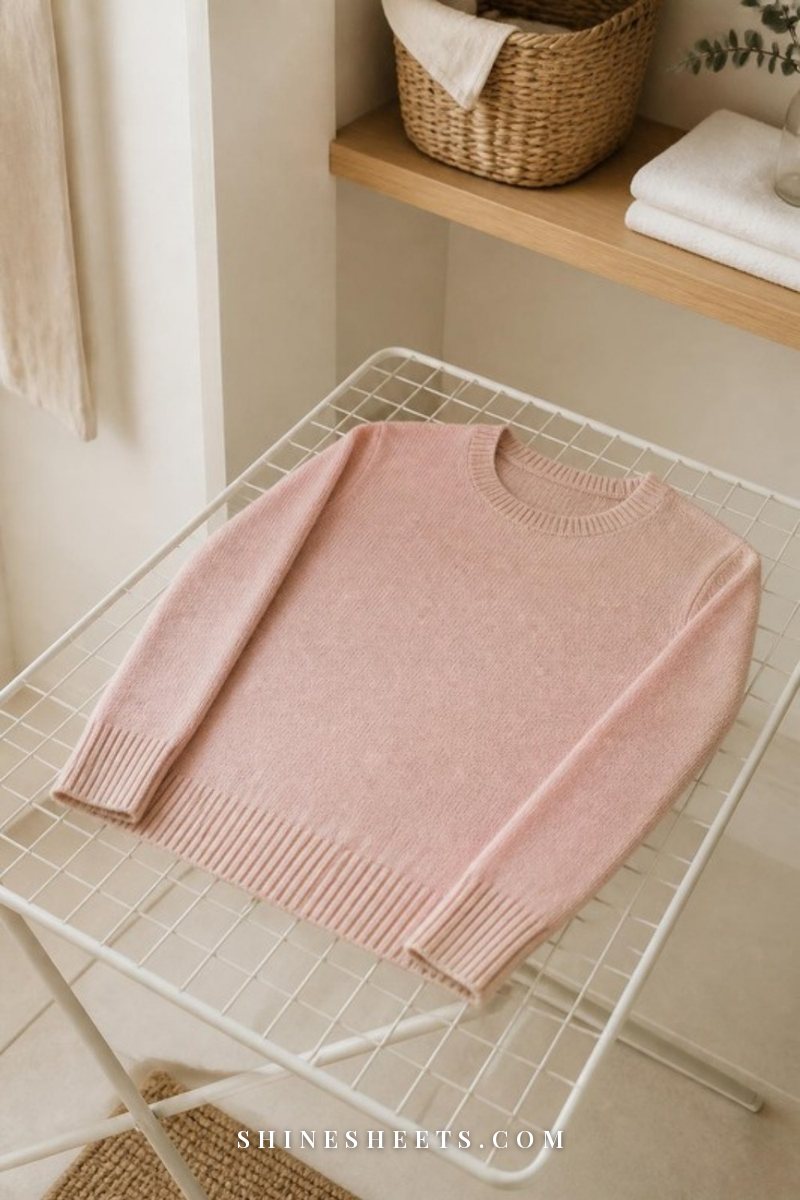
Drying is where most sweaters lose their shape, because wet wool is heavy and stretchy. A hanger pulls the shoulders into points and lengthens the whole body. Drying flat keeps everything where it belongs.
Lay your sweater on a fresh dry towel or, even better, on a flat mesh sweater drying rack so air can reach both sides and it dries faster. Then reshape it while it's damp:
- Smooth the body with your palms from the center outward.
- Line the sleeves up straight alongside the body.
- Gently push the ribbed cuffs and hem inward so they sit snug.
- Pat the neckline into a neat curve.
Keep it away from radiators, heated floors and direct sunlight, which can yellow light colors and make fibers brittle. Flip the sweater once after a few hours. Most knits take 12–24 hours to dry; chunky wool can take up to two days. It should feel completely dry, including the armpits, before you fold it away.
How To Remove Pilling: Comb vs Shaver
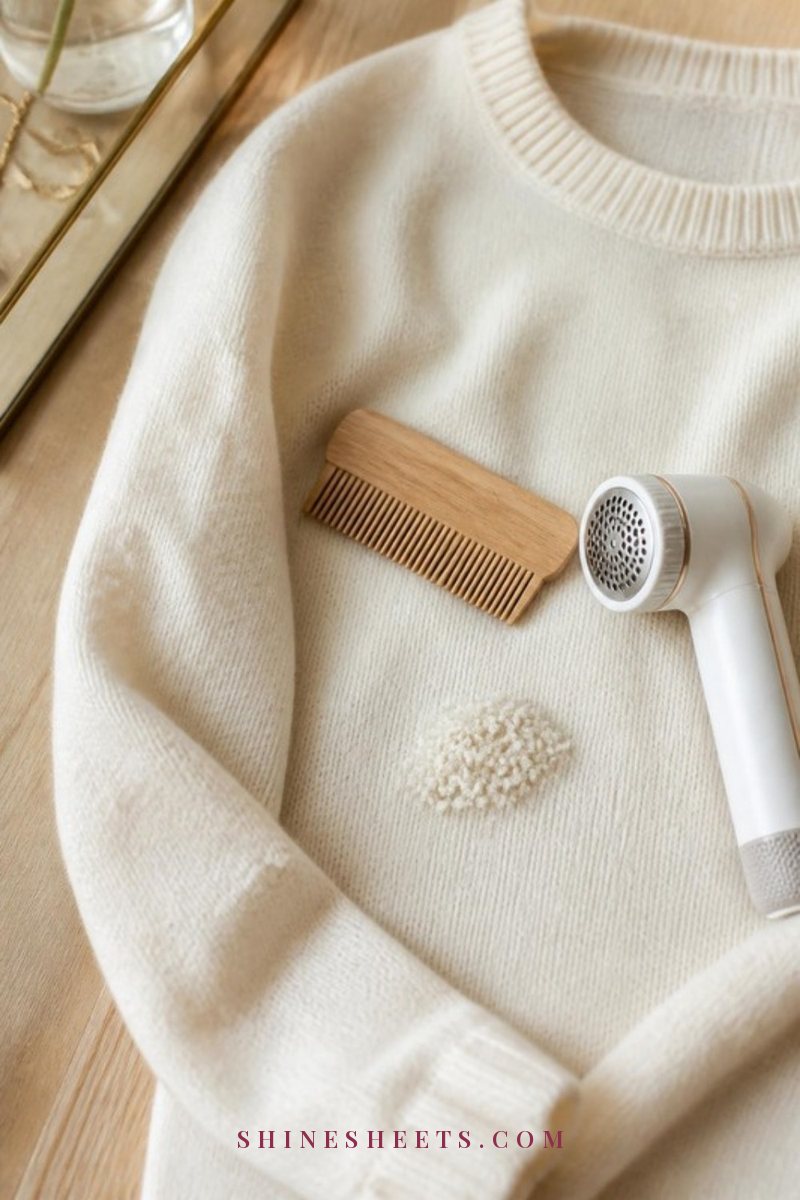
Pilling happens when short fibers work loose with friction – under bag straps, at the sides where your arms move, at the cuffs. It's not a sign of a bad sweater. Even very good cashmere pills during its first few wears, and it usually settles down once the loose fibers are gone.
There are two main tools, and they do different jobs:
| Cashmere comb | Fabric shaver | |
|---|---|---|
| Best for | Fine cashmere, light pilling, delicate knits | Thicker wool, blends, heavy pilling over large areas |
| How it works | A fine-toothed comb lifts pills off by hand | Rotating blades under a guard cut pills away |
| Speed | Slower, very controlled | Fast |
| Risk | Very low | Can snag or thin fabric if pressed too hard |
| Tip | Short, light strokes in one direction | Lowest setting, fabric laid flat, no pressure |
For fine knits, I'd choose a wooden cashmere comb: lay the sweater flat on a table, hold the fabric taut with one hand and glide the comb across the pilled area in short strokes. For thicker wool or a pilled-all-over blend, a rechargeable fabric shaver is quicker – look for one with an adjustable height guard and use it on the lowest pressure, moving in small circles.
Always depill a clean, dry sweater on a flat surface, never while wearing it. And to slow pilling down, rotate your knits, avoid rough crossbody straps on your favorite cashmere, and wash inside out.
Sweater Care Cheat Sheet by Fiber
Not every wool behaves the same way. Cashmere is fine and soft, merino is tougher, lambswool is cozy but pills more, mohair has that halo you don't want to flatten. Here's a quick reference – screenshot it and keep it on your phone for laundry day.
| Fiber | Wash | How often | Dry | Depill with | Watch out for |
|---|---|---|---|---|---|
| Cashmere | Hand wash cool, wool wash; machine wool cycle for sturdy pieces | Every 3–5 wears (fewer with a layer underneath) | Flat, reshaped | Cashmere comb | Heat, hangers, rough bag straps |
| Merino | Machine wool cycle often fine (check label), cold | Every 4–6 wears | Flat | Comb or shaver | Fabric softener, high spin |
| Lambswool | Hand wash cool or wool cycle | Every 5–8 wears | Flat, give it extra time | Fabric shaver | Pilling at sides and cuffs |
| Mohair | Hand wash only, cool, minimal handling | Rarely – air it out instead | Flat, then shake gently | Rarely needed; pick off by hand | Brushing or rubbing that flattens the halo, snags |
| Alpaca | Hand wash cool | Every 5–8 wears | Flat (it stretches when wet) | Comb | Hanging, which lengthens the body |
| Wool/cashmere blends | Follow the most delicate fiber; wool cycle usually fine | Every 3–5 wears | Flat | Fabric shaver | Synthetic blends pill more and hold odor |
When in doubt, treat a sweater like cashmere. Gentle care never hurt a sturdy knit, but sturdy care can ruin a delicate one.
How To Store Cashmere and Wool Sweaters
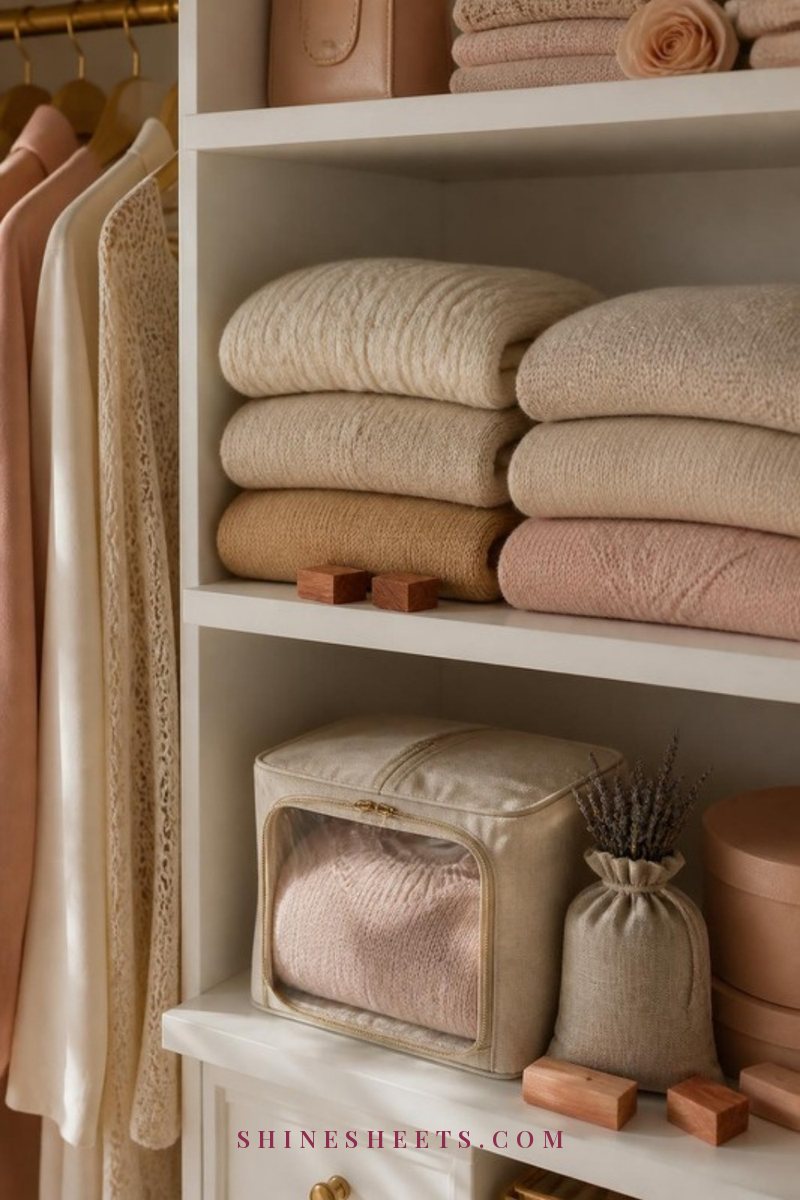
Storage is where sweaters either rest or quietly get ruined. These are the habits that matter most:
Fold, Don't Hang
Knits stretch under their own weight on a hanger, and you'll find shoulder bumps that never quite steam out. Fold sweaters and store them flat on a shelf or in a drawer, heaviest at the bottom, no more than three or four in a stack so the bottom ones don't get crushed. For a lighter knit you really want to hang (say, in a small closet), fold it in half lengthwise and drape it over the bar of a padded hanger instead of hanging it by the shoulders.
If your sweater shelf has turned into a tumbling pile, my guide on how to organize a closet has easy ways to create a dedicated knitwear zone.
Use Breathable Storage, Not Plastic
Wool needs to breathe. Sealed plastic traps moisture, which can lead to musty smells, yellowing and even mildew. For seasonal storage, I'd choose breathable zippered sweater storage bags in cotton or linen-look fabric with a clear window, so you can see what's inside without unpacking everything. A cotton pillowcase works too for one or two pieces.
Add Cedar (and Refresh It)
Tuck a few natural cedar blocks or rings between stacks or in each storage bag. Cedar's natural oils help deter moths and keep everything smelling fresh. The scent fades after a few months, though, and with it the effect, so lightly sand the blocks with fine sandpaper each season to wake them up. Lavender sachets are a pretty addition for scent, just don't rely on them alone.
Store Only Clean, Fully Dry Knits
This one bears repeating. Anything you pack away for the summer should be freshly washed and completely dry. A sweater that "looks fine" but was worn once in October is an open invitation to moths by April.
Moth Prevention That Actually Works
Clothes moths aren't attracted to the wool itself so much as to the keratin, sweat and food traces on worn fabric. The adult moths you see fluttering don't eat anything – it's the tiny larvae, hiding in dark, undisturbed corners, that make the holes. That's why prevention is mostly about cleanliness and disturbance.
- Wash before storing, every single time.
- Disturb your closet regularly. Larvae hate light and movement. Take things out, shake them, vacuum the corners and shelf edges once a month in sweater season.
- Use cedar and lavender as a deterrent, and refresh them seasonally.
- Air sweaters in daylight for an hour or two after storage, then brush gently with a clothes brush to dislodge any eggs.
- Use pheromone moth traps in the closet if you've seen moths – they catch males and show you whether you have a problem.
- Freeze anything suspect. If you find a hole or larvae, seal the sweater in a zip bag, freeze it for about a week, then let it come back to room temperature before washing. Wash and vacuum the whole closet area too.
A gentle safety note: I'd skip old-fashioned mothballs, especially in bedrooms and homes with children or pets. They contain strong chemicals, the smell clings to clothes for ages, and they're not something you want to breathe in for months. Cleanliness and cedar do the job more kindly.
How To Remove Wrinkles and Freshen Between Wears

Steam is your sweater's best friend. It relaxes creases from folding, revives flattened fibers and freshens a knit between washes, all without the heat and pressure of an iron.
A compact handheld garment steamer is ideal: hold it a few centimeters away from the fabric (never pressing directly on it) and move slowly over creases. You can steam a sweater briefly on a padded hanger, then lay it flat to cool and settle. No steamer? Hang the sweater in the bathroom while you take a hot shower – the steam does a gentler version of the same job.
If you must iron, turn the sweater inside out, use the wool setting and place a damp cotton cloth between the iron and the knit. Press, lift and move – don't glide back and forth.
To freshen a sweater between washes, air it near an open window or outdoors in the shade for an hour. A light mist of water followed by drying flat also helps release odors. Skip perfumes and fabric sprays with alcohol directly on cashmere – they can dry out the fibers and leave marks.
How To Fix Stretched Cuffs and Necklines
Cuffs that slide down over your hands or a neckline that has slowly widened are common, especially on cashmere. Natural fibers have some memory, so you can often coax them back:
- Dampen the stretched area with warm (not hot) water, either by dipping just the cuff or by misting the neckline until it's properly wet.
- Scrunch it gently inward with your fingers, pushing the ribbing back together so it looks a little tighter than you want.
- Dry it with gentle warmth: a hairdryer on a warm, low setting held at a distance, keeping the fabric scrunched as it dries. The combination of moisture and warmth encourages the fibers to contract slightly.
- Let it settle flat for a few hours before wearing.
Go slowly and check often – you're aiming for a little tighter, not felted. For a neckline that's badly stretched, a tailor or knitwear specialist can run a fine elastic thread or yarn through the inside of the ribbing, which is invisible from the outside. To prevent it in the first place, don't push sleeves up over your elbows all day and don't pull sweaters off by the neckline.
How To Pack Sweaters for Travel
Knits are wonderful travel companions: they're warm, they resist odors and they rarely need washing on a short trip. A few tricks keep them looking good:
- Wear the bulkiest one on travel day, especially for flights, where cabins can be cold anyway.
- Fold, then roll loosely. Fold the sleeves in, fold in half lengthwise, then roll softly from the hem up. Rolling too tightly creates its own creases.
- Use a soft packing cube or cotton bag to protect knits from zippers and shoe buckles.
- Hang it in the bathroom during your first shower at your destination to release travel creases.
- Pack a small travel-size wool wash for longer trips, so you can hand wash in the hotel sink and roll it in a towel.
For the rest of your bag, my carry-on packing list helps you travel light without forgetting the essentials.
8 Sweater Care Mistakes To Avoid
If a sweater has ever come out of the wash looking smaller, fuzzier or strangely long, one of these is usually behind it. No judgment – most of us learned them the hard way.
- Washing in warm or hot water. Keep it cool, always.
- Using regular detergent. Enzymes and harsh surfactants break down protein fibers over time.
- Wringing or twisting. Press and roll instead.
- Tumble drying. Not even once, not even on low.
- Hanging knits on regular hangers. Fold them, or fold them over the bar of a padded hanger.
- Storing worn sweaters for the season. Clean before storing, every time.
- Sealing knits in plastic. Choose breathable bags.
- Depilling while wearing it. Lay it flat on a table so you don't snag or thin the fabric.
Good care also makes it easier to buy fewer, better sweaters. If you're building a smaller wardrobe around pieces you truly love, a capsule wardrobe pairs perfectly with a few well-kept knits, and a soft cream cashmere crewneck is the backbone of so many old money outfits. For styling ideas on cold days, browse my winter outfit ideas.
Final Thoughts
Learning how to care for cashmere and wool really comes down to a handful of gentle habits: wash less, wash cool, never wring, dry flat, fold instead of hang and store everything clean. None of it takes much time, and every bit of it pays you back in sweaters that stay soft and shapely.
Treat your favorite knits like the small luxuries they are, and they'll keep you warm for many winters to come. There's something quietly lovely about pulling out the same cream sweater year after year and finding it just as soft as the day you fell for it.