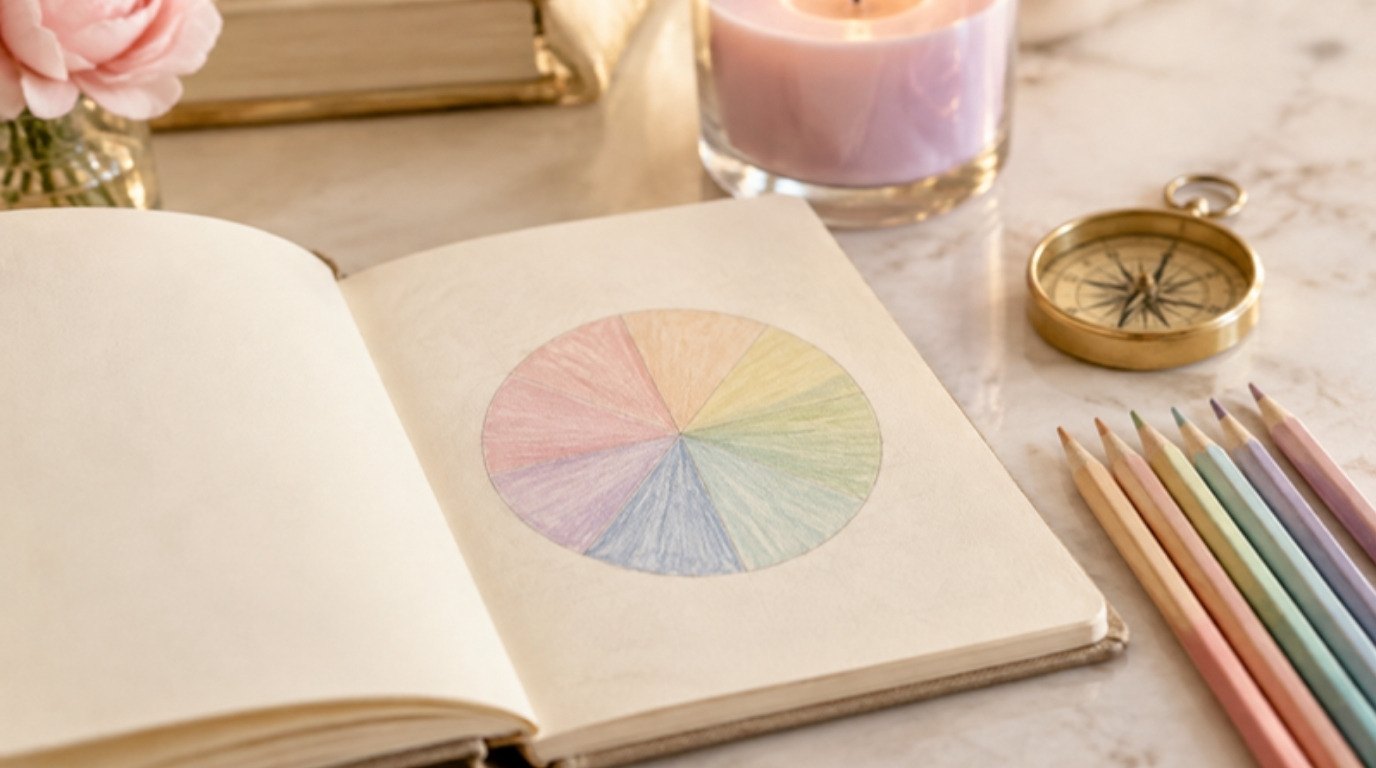
Most of us get by with a feelings vocabulary of about four words: fine, stressed, tired and "ugh." The trouble is that "stressed" can mean five completely different things. It can mean you're scared of letting someone down, angry that your time isn't respected, sad that a plan fell through or simply overwhelmed by too many tabs open in your head. Each of those needs something different, and you can't give yourself the right thing until you know which one it is.
That's exactly what an emotion wheel is for. It's a simple circle of feeling words that helps you move from a vague, foggy "I feel bad" to something precise, like "I feel disappointed and a little left out." That shift sounds small. In practice, it changes how you talk to yourself, how you ask for help and how quickly a hard feeling starts to soften.
In this guide to the emotion wheel, I'll explain how the wheel works in plain words, why naming a feeling helps so much, the six core emotions with finer words for each, a five-step way to use it, a quick-reference table you can screenshot and a few everyday places it fits beautifully, from your journal to a tricky conversation with someone you love.
This isn't about fixing feelings. It's about getting to know them a little better, with curiosity instead of judgment.
What Is an Emotion Wheel?

An emotion wheel is a circle divided into slices, with a handful of core emotions in the centre and more specific feeling words in the rings around them. The closer you get to the edge, the more precise the words become. "Fear" in the middle might lead outward to "anxious," then further out to "overwhelmed" or "insecure."
The idea has a lovely history. Psychologist Robert Plutchik created a well-known wheel of emotions that shows how basic feelings blend and vary in intensity, and therapist Gloria Willcox later designed The Feeling Wheel to help people find the words for what they felt. Today you'll find dozens of versions, and they don't all agree on the exact number of core emotions. That's okay. No wheel is the "correct" one. They're all tools for the same job: giving your inner world more words.
The version I'll walk you through uses six core emotions that many modern wheels share: joy, sadness, anger, fear, surprise and disgust. It's simple enough to remember without looking, which matters when you're in the middle of a feeling and don't want to hunt for a chart.
One small but important note before we start: the wheel isn't a test, and you can't use it "wrong." If you land on three words at once, that's normal. Feelings overlap all the time.
Why Naming a Feeling Helps

It might seem like naming a feeling is just a nice extra. It's actually one of the most useful things you can do with an emotion, and there are three big reasons why.
Name It To Tame It
"Name it to tame it" is a phrase psychiatrist Dan Siegel made popular, and it captures something researchers call affect labeling: putting a feeling into words tends to turn its volume down a little. You're not ignoring the emotion or arguing with it. You're simply stepping half a pace back and saying, "Oh, this is frustration." That half pace often gives you just enough room to breathe before you react.
As someone prone to anxiety, I find this one especially helpful. "I feel awful" spirals. "I feel nervous about tomorrow's call" is something I can actually work with.
Clearer Needs
Every feeling carries a little message about what you need. Loneliness points toward connection. Resentment often points toward a boundary. Tiredness that looks like sadness might simply point toward sleep. When the feeling stays vague, the need stays vague too, and you end up reaching for whatever is closest (the phone, the snack cupboard, an extra episode) instead of what would actually help.
Kinder Conversations
Precise words make conversations softer. "You never listen" puts the other person on the defensive. "I felt dismissed when my idea got skipped in the meeting" invites them in. When you know what you feel, you can share it without blaming, and people tend to respond with much more care. If you'd like to build this skill further, my guide to improving your emotional intelligence in everyday life goes deeper into reading your own feelings and other people's.
The 6 Core Emotions on the Wheel
Here are the six core emotions in the centre of the wheel, with some of the finer words that grow out of each one. Read them slowly. You might notice a word that fits something you've felt this week but never quite named.
1. Joy

Joy is the warm, open, "yes" feeling. It isn't only big happiness. It also includes the quieter, everyday versions that are easy to overlook.
- Finer words: content, grateful, proud, hopeful, playful, peaceful, delighted, relieved, inspired, loved.
- A small tip: naming joy matters as much as naming hard feelings. "I feel content right now" helps you notice and savor good moments instead of rushing past them.
2. Sadness

Sadness is the heavy, slowing-down feeling that shows up around loss, disappointment and change. It often asks us to be gentle and to let something matter.
- Finer words: disappointed, lonely, hurt, homesick, discouraged, grieving, left out, nostalgic, empty, tender.
- A small tip: "lonely" and "left out" feel similar but need different things. Lonely might want any warm company. Left out might want a word with one specific person.
3. Anger
Anger is the hot, energized feeling that often appears when something feels unfair, a boundary is crossed or you feel unheard. It has a bad reputation, but it's frequently a protector.
- Finer words: irritated, frustrated, resentful, annoyed, jealous, betrayed, impatient, offended, bitter, fed up.
- A small tip: anger often sits on top of something softer. If you look underneath "furious," you might find "hurt" or "scared." Both are worth knowing.
4. Fear
Fear is the alert, bracing feeling that switches on when something seems uncertain or unsafe. In everyday life, it rarely looks like terror. It looks like worry, doubt and that tight feeling before a hard email.
- Finer words: anxious, nervous, insecure, overwhelmed, worried, vulnerable, panicky, unsure, embarrassed, exposed.
- A small tip: "overwhelmed" is one of the most useful words on the whole wheel. It usually means "too much at once," which points straight to a solution: fewer things, smaller steps.
5. Surprise
Surprise is the quick "oh!" feeling when something unexpected happens. It's often brief and then tips into another emotion, like delight or alarm.
- Finer words: amazed, startled, confused, shocked, curious, moved, astonished, caught off guard, speechless, intrigued.
- A small tip: when surprise lingers, check which way it's leaning. "Caught off guard" in a meeting might really be "embarrassed," which is closer to fear.
6. Disgust
Disgust is the pulling-away feeling. It began as protection from things that could make us sick, and it also shows up when something clashes with our values.
- Finer words: uncomfortable, repelled, disapproving, judgmental, appalled, uneasy, put off, contemptuous, averse, turned off.
- A small tip: disgust aimed at yourself often sounds like shame. If you catch "I'm disgusted with myself," treat it as a cue for extra kindness, not more criticism.
The Emotion Wheel at a Glance
This is the quick-reference version: one row for each core emotion, a few finer words, where you might notice it in your body and what it might be asking for. Screenshot it and keep it on your phone or tuck a copy into your journal. The body cues are common patterns, not rules, so trust what you notice in yourself.
| Core emotion | Finer words | Common body cue | What it might need |
|---|---|---|---|
| Joy | Content, grateful, proud, hopeful | Lightness in the chest, relaxed shoulders, easy smile | To be noticed, savored and shared |
| Sadness | Disappointed, lonely, hurt, left out | Heavy limbs, tight throat, tired eyes | Comfort, rest, connection, time |
| Anger | Frustrated, resentful, irritated, betrayed | Heat in the face, clenched jaw, tense hands | A boundary, to be heard, movement |
| Fear | Anxious, overwhelmed, insecure, nervous | Fluttery stomach, fast breathing, raised shoulders | Safety, reassurance, smaller steps |
| Surprise | Startled, confused, amazed, caught off guard | Wide eyes, quick breath in, a pause in the body | A moment to process before reacting |
| Disgust | Uncomfortable, disapproving, uneasy, put off | Turning away, nose wrinkling, queasy stomach | Distance, clarity about your values |
How To Use an Emotion Wheel in 5 Steps
You can do this in two minutes in a quiet corner, or take twenty with a notebook. The steps are the same either way.
1. Pause

Stop what you're doing for one slow breath, or three if you can. Put down the phone, close the laptop lid halfway or simply rest your hands in your lap. You're giving the feeling a moment to be looked at instead of acted on.
If it helps to make this a ritual, light a lavender scented candle in a glass jar when you sit down to check in. The scent becomes a cue that says, "Now we listen." Blow it out before you leave the room.
2. Start at the Centre
Look at the six core emotions and ask, "Which one is closest?" Don't overthink it. If nothing fits, choose the one that's "a little bit true." It's fine to pick two. Sad and angry often show up together, and so do fear and surprise.
3. Move Outward
Now move one ring out and read the finer words in that slice. Say a few of them quietly in your head and notice which one makes something inside you go "yes, that." It's a surprisingly physical feeling of recognition. If no word fits, try a neighboring slice. Sometimes what you thought was anger turns out to be disappointment.
Try to finish with a short sentence, not just a word: "I feel left out because I saw photos from a dinner I wasn't invited to." The "because" part is where the clarity lives.
4. Check In With Your Body

Feelings live in the body as well as the mind, and the body often knows first. Scan slowly from your forehead down: jaw, throat, shoulders, chest, stomach, hands. Where is there tightness, heat, heaviness or buzz? Use the table above as a gentle guide, not a diagnosis.
If the word you chose and your body don't match, that's useful information. "I'm fine" with a clenched jaw might deserve a second look. Wrapping yourself in a soft cream knit throw while you do this can make the scan feel safer and slower, especially in the evening.
5. Ask What You Need
Finish with one simple question: "What would help, even a little?" Look at the last column of the table for ideas. Then pick one small, doable thing:
- If it's sadness: text one person, take a warm shower or allow yourself an early night.
- If it's anger: take a ten-minute walk before replying, or write the message you won't send.
- If it's fear: write down the next tiny step only, not the whole plan.
- If it's joy: pause for ten seconds and really take it in, or share it with someone.
Sometimes the answer is "nothing right now, I just needed to know." That counts too. Naming the feeling was the help.
Everyday Ways To Use the Emotion Wheel
The wheel is most powerful when it becomes a habit rather than an emergency tool. Here are three gentle places to bring it into everyday life.
In Your Journal

Journaling and the emotion wheel are a natural pair. Try a simple three-line check-in at the end of the day:
- Today I mostly felt… (one core emotion)
- More specifically, I felt… because…
- Tomorrow, what would help is…
A guided reflection journal with gentle prompts can make this feel less like a blank page and more like a conversation. I also love the idea of color-coding: a set of pastel gel pens, one shade per core emotion, so that after a few weeks you can flip back and see the colors of your month at a glance. Add it to your evening tea ritual and it takes about five minutes. If you need more prompts, my list of journaling ideas for when you don't know where to start has plenty for tired, anxious and happy days.
Before a Hard Conversation
Before you talk to a friend, a family member or a coworker about something that bothered you, spend three minutes with the wheel. Find the specific word and write a short "I" sentence you can actually say out loud:
- The formula: "I felt [specific word] when [what happened], and I'd love [what you need]."
- Example: "I felt overlooked when the plans were made without me, and I'd love to be included next time."
This keeps the conversation about your experience rather than their character, which makes it far easier for the other person to hear you. It also stops a tiny irritation from coming out as a big explosion three weeks later.
With a Partner

The emotion wheel can be a sweet, low-pressure way to check in with a partner, especially if one of you finds it hard to talk about feelings. Once a week, maybe on a quiet Sunday evening with a pot of something warm from an herbal tea sampler, take turns answering two questions:
- "Which word on the wheel fits your week best?"
- "Is there anything you need from me with that?"
The rule is to listen, not fix. If your partner says "frustrated," you don't need to solve their week. A simple "that sounds like a lot, thank you for telling me" is often all it takes to feel closer. This works between friends and between a parent and an older child, too.
All Feelings Are Valid (Even the Uncomfortable Ones)
It's easy to look at the wheel and quietly sort the words into "good" and "bad" feelings. Joy and peace on one side, anger and jealousy on the other. I'd like to gently offer a different view: there are no bad feelings, only comfortable and uncomfortable ones.
Every emotion on the wheel exists for a reason. Anger can protect your boundaries. Fear can keep you careful. Sadness can help you let go and lets other people know you need support. Even jealousy can show you something you want for yourself. What matters isn't whether you feel something, but what you do with it, and naming it is usually the first step toward choosing a kind response.
Feeling an emotion is also different from acting on it. You can feel furious and still speak calmly. You can feel jealous and still be happy for your friend. Both things can be true at once. When you'd like practical ways to calm a big feeling after you've named it, my guide to gentle emotional regulation skills picks up right where this one ends, and if feelings tend to get pushed down and stored away, you might like these steps on how to process your emotions instead of bottling them up.
When It Feels Hard To Find Any Word
Some days, you'll look at the whole wheel and nothing will land. That doesn't mean you're doing it wrong. A few gentle things to try:
- Start with the body only. "My chest is tight and my shoulders are up" is a perfectly good check-in.
- Use "a bit." "I'm a bit sad, a bit tired" is easier to admit than one big word.
- Try again later. Feelings often become clearer after a walk, a shower or a night's sleep.
If you often feel flat, empty or cut off from your emotions, that experience has a name too, and it's more common than people think. My article on why feeling numb happens and gentle ways to feel again might help.
And please hear this: if feelings regularly feel overwhelming, if you feel numb most of the time or if emotions are getting in the way of daily life, a therapist or counselor can help you make sense of them. Reaching out isn't a sign that the wheel "didn't work." It's another kind and brave way of listening to yourself. This article is for general wellbeing and isn't a substitute for professional care.
Final Thoughts
An emotion wheel won't make hard feelings disappear, and it isn't meant to. What it does is quieter and, I think, more lasting: it helps you meet yourself with a little more understanding, one precise word at a time.
Start small. One check-in tonight, one word, one tiny need. Over time those little moments add up to a much kinder relationship with your own heart, and that's something worth practicing gently, for as long as you like.