Dating after something that hurt you doesn't require you to become fearless first. It requires something quieter: a slower pace, a few clear choices you make ahead of time, and the willingness to let a new person show you who they are over weeks instead of hours. Trust isn't a leap you take on the first date. It's something you build, a little at a time, with evidence.
If you're coming out of a relationship that left you anxious, second-guessing yourself or a bit numb, it makes complete sense that dating feels different now. Your mind learned to stay alert, and it's doing its job. The goal isn't to switch that alertness off. It's to give it better information, so it can tell the difference between a real warning and an old echo.
This guide to dating after a toxic relationship is all about pacing and practical choices: how to tell if you're ready, how to go slowly without feeling like you're hiding, how to share your story in layers, and a calm way to check whether a feeling is an old fear or a genuine red flag. Keep a guided reflection journal or any notebook nearby. A few of the steps work best written down.
And one gentle permission before we start: if you read this and realize you're not ready yet, that is a perfectly good outcome too.
Why Dating After a Toxic Relationship Feels So Different

After a relationship with a lot of highs and lows, your nervous system can get used to intensity. Calm, steady people may feel a little boring at first, while someone who sweeps you off your feet feels oddly familiar. That isn't a flaw in you. It's simply what your body practiced for a long time.
You may also notice that small things land bigger than they used to. A slow reply, a change of plans or a joke at your expense can send your heart racing, even when the moment is harmless. And sometimes the opposite happens: you brush off something that genuinely isn't okay, because you got used to brushing things off.
If you want to understand where those patterns come from, my guide to healing trust issues gently goes deeper into the roots. Here, we'll stay practical and focus on what to actually do in early dating, one step at a time.
It took me a while to understand that feeling nervous isn't the same as being in danger. Both deserve attention, but they ask for different responses, and a lot of this guide is about learning which is which.
6 Signs You May Be Ready To Date Again

There's no perfect waiting period. Some people feel ready after a few months, others after a few years. These six signs are a kinder measure than the calendar. You don't need all of them, but if most feel true, you're probably on solid ground.
1. You Know Your Non-Negotiables
You can name three to five things you will not accept again, in plain words. For example: "I won't date someone who checks my phone," or "I need a partner who respects my friendships." Write them down. If you can list them without second-guessing, you have a compass for early dating. My article on dating standards every woman should have can help you put them into words.
2. You Want Company, Not Rescue
There's a difference between "I'd love to share my life with someone" and "I need someone to make this pain stop." The first is a lovely reason to date. The second puts a heavy job on a stranger and can pull you toward people who enjoy being needed a little too much.
3. You Can Think About Your Ex Without Spiraling
You may still feel sad, angry or confused sometimes, and that's normal. Readiness looks more like this: a memory comes up, you feel it, and it passes within an hour or so instead of taking over your whole evening.
4. Your Days Feel Like Yours Again
You have routines, friends and small pleasures that belong to you. Evening tea, a walk you love, a hobby you picked back up. When your life feels full on its own, a new person becomes a lovely addition instead of the whole plan.
5. You Can Say No Without a Long Apology
Try a tiny test this week: turn down one small request with a simple "That doesn't work for me, but thank you." If it feels uncomfortable but doable, that's a great sign. Saying no clearly is one of the most protective skills you can bring into dating.
6. You Trust Yourself a Little More Than Before
Not completely, and not all the time. But you notice when something feels off, and you're more willing to act on it. If you're not sure where you are with this, my list of signs you are healing emotionally is a gentle way to check in.
If only one or two of these feel true right now, waiting longer is completely fine. Healing isn't a race, and the right person will still be out there when you're ready.
How To Go Slowly in Early Dating
Going slowly isn't about playing hard to get or keeping score. It's about giving yourself enough time and information to make good choices. Here are six practical ways to keep the pace steady.
Keep First Dates Short and Public
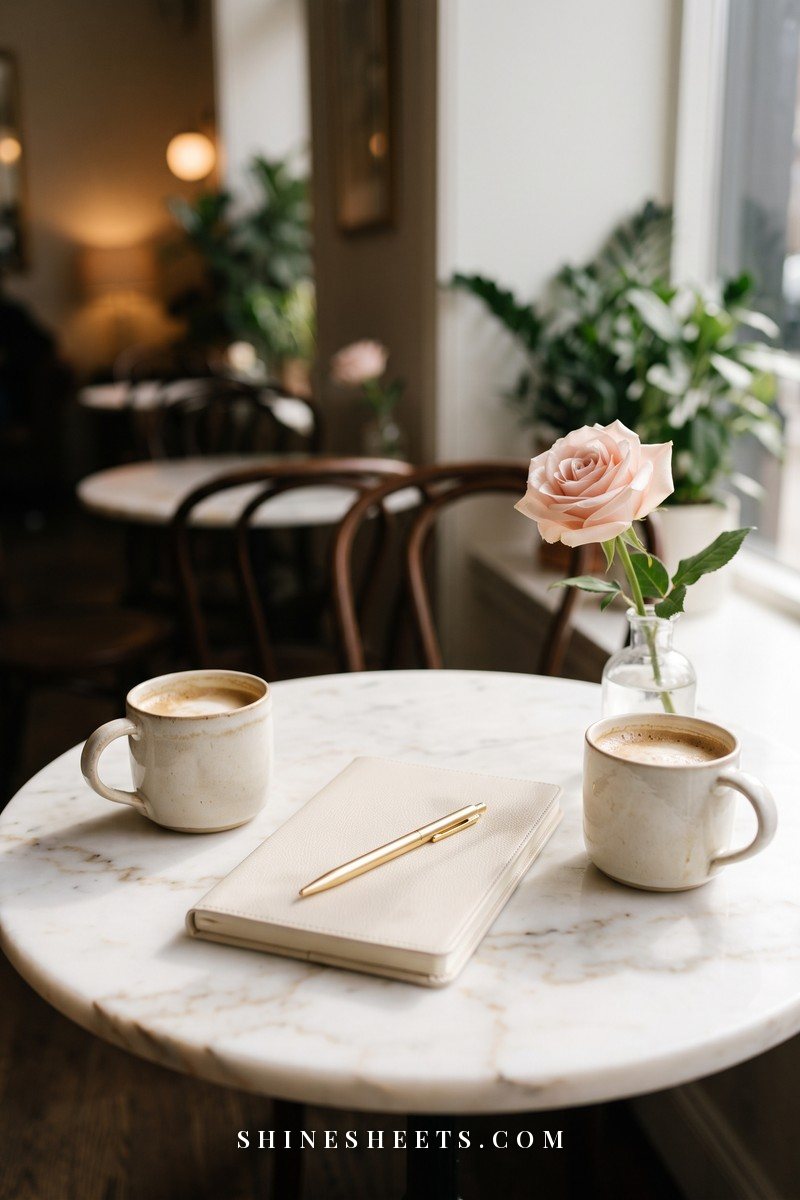
Plan first dates for 60 to 90 minutes in a busy, daytime place: a coffee shop, a park walk with other people around, a casual lunch. Short dates take the pressure off. If it goes well, you leave wanting more. If it doesn't, you're home before dinner.
Arrange your own way there and back, and keep your home address to yourself for the first few dates. A soft, comfortable layer like a blush knit cardigan can make a nervous afternoon feel a bit more like you.
A simple script for setting it up: "I'd love to meet for coffee on Saturday afternoon. How about 2 o'clock at the place on the corner?" Clear, friendly and easy to say yes to.
Tell a Friend Your Plans
Before each early date, send one trusted friend the basics: the person's first name, where you're going and roughly when you'll be home. Agree on a quick "home safe" text afterward. It takes thirty seconds and gives you a quiet sense of backup.
A friend is also a lovely sounding board. If you catch yourself explaining away something that bothered you, a friend who knows your story can gently say, "Hmm, that sounds like something you told me you didn't want again."
Share Your Story in Layers
You don't owe anyone your whole history on a first date, and you don't have to hide it either. Think of it in three layers:
- Early dates: "I'm coming out of a hard relationship, so I like to take things slowly." That's enough.
- After a few weeks of steady contact: a little more about what you learned and what matters to you now.
- When trust has been earned over time: the fuller story, if and when you want to share it.
Watch how someone responds to the first layer. A good match says something like "Of course, no rush." Someone who pushes for details, criticizes your ex at length or treats your past as a reason to rush you is giving you useful information.
Look for Consistency Over Intensity

Intensity is the big gesture, the three-hour phone call, the "I've never felt this way." Consistency is quieter: they text when they say they will, they show up on time, their words this week match their words last week. Consistency is far more telling.
A useful rule of thumb: give it about three months of regular dating before you decide how much someone can be trusted. People can keep up a charming act for a few dates. It's much harder to fake steadiness over a whole season.
Notice Love Bombing vs Genuine Interest
After a toxic relationship, it's natural to be wary of anyone who seems very keen. Genuine interest and love bombing can look similar at first, so look at how they handle your pace.
- Genuine interest is warm, curious and patient. They ask to see you again, and they're fine when you say next week works better.
- Love bombing is fast and overwhelming: constant messages, early talk of forever, big gifts, sulking or pressure when you want space.
If you want more examples, my guide to love bombing signs and how it differs from real love breaks it down clue by clue.
Say I Need To Slow Down Calmly
Slowing down is allowed at any point, even after a lovely date. You don't need a dramatic reason. A few calm ways to say it:
- "I'm really enjoying getting to know you, and I'd like to keep a slower pace. Can we stick to once a week for now?"
- "I'm not ready to meet your friends yet, but I'd love to do another coffee."
- "I need a little space to think this weekend. I'll message you on Monday."
Then notice the reaction. Respect, maybe a little disappointment, and then patience: lovely. Guilt-tripping, anger or a sudden cold shoulder: that tells you a lot, early, when it's easiest to step away.
Old Fear or a Real Red Flag?

This is the question that keeps many people awake after a date. The tricky part is that both can feel exactly the same in your body: tight chest, racing thoughts, a sudden urge to cancel. So instead of judging by the feeling alone, look at the facts.
Ask yourself three quick questions:
- What actually happened? Write it in one plain sentence, as if a stranger were describing it. "He replied six hours later" is a fact. "He doesn't care about me" is a story.
- Is this a pattern or a moment? One late reply is a moment. Several cancelled plans with no apology is a pattern.
- Did they respect a boundary? If you said no or asked for space, did they honor it?
If the honest answers are "a small thing, once, and they respected me," it's probably an old fear asking for reassurance. If they are "something that crossed a line, more than once, or after I asked them to stop," take it seriously, even if the person is otherwise charming. My list of real red flags and green flags in dating has plenty of concrete examples on both sides.
One honest admission: I'm prone to anxiety, and my first reaction to uncertainty is often to assume the worst. Writing the plain facts in a cream linen notebook after tea has helped me more than any amount of overthinking. The page doesn't panic.
The Early Dating Grounding Table
Here are common early dating moments, the reaction an old hurt might trigger, a grounded check, and a kind next step. Screenshot it and look at it before you reply to a message you're unsure about.
| Early dating moment | Old fear reaction | Grounded check | Kind next step |
|---|---|---|---|
| They take a few hours to reply | They're losing interest, I said something wrong | Is this their usual rhythm? Have they been steady otherwise? | Put the phone away for an hour, then reply as you normally would |
| They cancel a date | Here we go again, I'm not a priority | Did they apologize and suggest a new time? | Accept the new time, or say "No worries, let me know when works" |
| They say something kind and generous | This is too good, there must be a catch | Do their actions match their words over time? | Say thank you and simply enjoy it, then keep watching for consistency |
| They ask about your past | If I tell them, they'll use it against me | Have they earned this layer yet? | Share the first layer only: "It was hard, and I'm taking things slowly" |
| They disagree with you | Conflict means it's about to get ugly | Were they respectful while disagreeing? | Share your view calmly and notice whether they listen |
| They want to move faster | If I say no, I'll lose them | Is the pace comfortable for me? | Say "I like you and I want to keep a slower pace" |
| You feel a sudden urge to end it | I should run before I get hurt | Did something actually happen, or am I just scared? | Wait 24 hours, write the facts down, then decide |
Notice that none of the next steps involve testing someone, going silent to see if they chase you, or playing games. Steady, honest behavior from you invites steady, honest behavior back, and it makes it much easier to spot when something truly isn't right.
Caring for Yourself Between Dates

Early dating can stir up a lot, even when it goes well. What you do between dates matters just as much as the dates themselves.
- Keep your own plans. Don't cancel your friend dinner or your evening walk because someone new might message. Your life stays yours.
- Limit the replay. Give yourself 15 minutes to think over a date, then do something else. Endless replaying feeds anxiety, not clarity.
- Check in with your body. After each date, ask: did I feel relaxed, tense, or on guard? Over a few dates, those notes say a lot.
- Wind down on purpose. A warm shower, a cup from an herbal tea sampler, a few sprays of lavender pillow mist and an early night help your nervous system settle after a big day.
- Keep seeing your people. Friends who knew you before and after the hard relationship are your best reality check.
If you notice a date leaves you more drained than happy again and again, that's worth paying attention to. Good connection, even when it's new and a bit nerve-racking, should leave you feeling more like yourself, not less.
It can also help to plan your own small rituals around dates, so each one has a clear beginning and end. Before: ten quiet minutes, a glass of water and a look at your non-negotiables list. After: the "home safe" text to your friend, a few lines in your journal about how you felt, and then something comforting that has nothing to do with the other person. Those bookends remind you that dating is one part of your week, not the center of it.
And if you decide to pause dating for a while, even in the middle of getting to know someone, you can. A simple "I've realized I need more time for myself right now, and I don't want to keep you waiting" is honest and kind. Stepping back is not failing. It's listening to yourself, which is exactly the skill you're rebuilding.
When To Get Extra Support
Sometimes the fear from a past relationship is bigger than any guide can hold, and that's okay. A therapist, especially one who works with relationship trauma, can help you untangle lingering fear, guilt or panic, so you don't have to carry it into every date.
If a past relationship is still affecting your safety, or if someone new starts to feel controlling, threatening or unsafe, please reach out to local support services or a trusted person right away. You deserve to feel safe, always. If you're unsure whether what you went through was toxic, my guide to the signs of a toxic relationship may help you name it.
Final Thoughts
Dating again after a toxic relationship is an act of quiet courage. You don't need to be fully healed, completely confident or free of every fear. You only need to go at a pace that feels safe, pay attention to what people do over time, and keep choosing yourself along the way.
The right person won't mind waiting while you find your footing. They'll be the one who makes slow feel lovely.