
A text message is a few words with all the warmth stripped out. No voice, no face, no little smile at the end of a sentence – just letters on a screen and a gap of silence your mind rushes to fill. When you care about someone, that gap almost always gets filled with the worst possible version of the story.
That's not because you're "too much" or "crazy". It's because your brain is doing its job: scanning for signs of rejection in a medium that gives it very little to work with. The kindest thing you can do is give it better tools than staring, rereading and screenshotting.
This guide is all about overthinking texts – why messages set off such big spirals, the most common ones (the short reply, the missing emoji, the read-but-no-answer), a table that pairs each text with the anxious story and the likely reality, and 7 calm ways to stop analyzing every message he sends. It works at any stage, from early dating to years in.
Keep a guided reflection journal close by. One of the most useful steps below happens on paper, not on your phone.
Why Texts Trigger So Much Overthinking

Overthinking texts usually isn't about the text at all. It's about what a message can't tell you, and what your mind fills in instead. Four things tend to drive it.
No Tone, No Face
In person, most meaning comes from tone, facial expression and body language. A text gives you none of that. "Ok" said with a warm smile is lovely; "ok" read at 11 p.m. when you're tired can feel like a door closing. Your brain has to guess the tone, and anxious brains guess cold.
The Waiting Gap
Waiting is uncomfortable for every human nervous system. When you've sent something meaningful and the reply hasn't come, your mind treats the silence as information – even though he might simply be driving, working, in the shower or asleep. The longer the gap, the more elaborate the story.
Old Hurt Shows Up
If someone in the past went quiet before leaving, ghosted you, or used silence as punishment, your body remembers. A slow reply now can feel exactly like that old experience, even when the person in front of you is completely different. That's not overreacting; it's your history asking to be heard.
Anxious Attachment Patterns
Some of us naturally lean toward wanting more closeness and reassurance in relationships. When that's your pattern, a text can feel like a thermometer for the whole connection. My guide to anxious attachment and how to feel more secure in love explains this in depth – it's a very common, very workable pattern.
The Most Common Texting Spirals
Most overthinking falls into a handful of familiar loops. Recognizing yours can take a surprising amount of the sting out:
- The short reply. You wrote a thoughtful paragraph, he wrote "haha nice". Your mind decides he's losing interest.
- No emoji, no exclamation point. He usually adds a smiley; today he didn't. Now everything feels flat.
- Read, but no answer. Those read receipts can feel unbearable. You check again, and again.
- The slow reply. He used to answer in minutes and now it takes hours, so you start counting.
- The rewrite loop. You draft, delete and redraft your own message for twenty minutes, then worry about how it landed.
- The thread replay. You reread the whole thread looking for the moment it "changed".
If you saw yourself in three or four of these, you're in very good company. The next section untangles them one by one.
Text You Got vs. the Likely Reality
Here's the unique part of this guide: a calm translation table. It won't tell you what he's thinking (nothing can), but it shows how often the anxious story isn't the most likely one, and what a grounded next step looks like.
| Text you got | Anxious story | Likely reality | Calm next step |
|---|---|---|---|
| "Ok" | He's annoyed with me. | He read it, agrees, and is busy. | Take it at face value. Carry on with your day. |
| "Haha nice" after your long message | He doesn't care about what I said. | He enjoyed it but is replying on the go. | Save the bigger story for a call or in person. |
| Read, no reply for hours | He's ignoring me on purpose. | He saw it at a busy moment and meant to answer later. | Set your phone aside for your next check-in window. |
| Reply took most of the day | He's pulling away. | Work, family, a tiring day, or simply a different texting rhythm. | Notice the pattern over weeks, not today. |
| No emoji this time | Something is wrong between us. | He typed quickly. | Let it go – one message isn't a mood report. |
| "Can we talk later?" | He's going to end it. | He wants to talk properly rather than type. | "Sure – is everything okay? Evening works for me." |
| Short replies all week | He's lost interest. | Possibly stress, possibly distance – worth asking. | Ask once, kindly and directly (see way 6). |
The last row matters. Sometimes the anxious story deserves a gentle check, and that's fine. The goal isn't to never wonder – it's to stop letting one message run your whole evening.
7 Ways To Stop Overthinking Texts
None of these require you to stop caring or play it cool. They're about getting your calm back so you can respond as the person you actually are.
1. Name the Story vs. the Fact

Grab your notebook and draw a line down the middle of the page. On the left, write only the facts: "He replied 'ok' at 4:12." On the right, write the story your mind is telling: "He's annoyed and getting bored of me."
Seeing them side by side is powerful. The fact column is almost always tiny and neutral. The story column is long and painful. You don't have to prove the story wrong – just notice that it's a story. If overthinking shows up in other areas of your life, too, my post on how to stop overthinking in 3 easy steps builds on this exact skill.
2. Wait Before You Reply to Your Own Worry
When anxiety spikes, the urge is to do something immediately: send a follow-up, ask "are you mad?", or double-text to fill the silence. Instead, give the worry 20 minutes before you act on it. Set a timer, make tea, step outside, fold laundry.
Most of the time, by the end of those 20 minutes, either he's replied or the spike has softened enough that you can decide calmly. This isn't a game or a strategic delay – you're not waiting to look busy. You're waiting so your nervous system, not your panic, makes the choice.
3. Set a Check-the-Phone Window
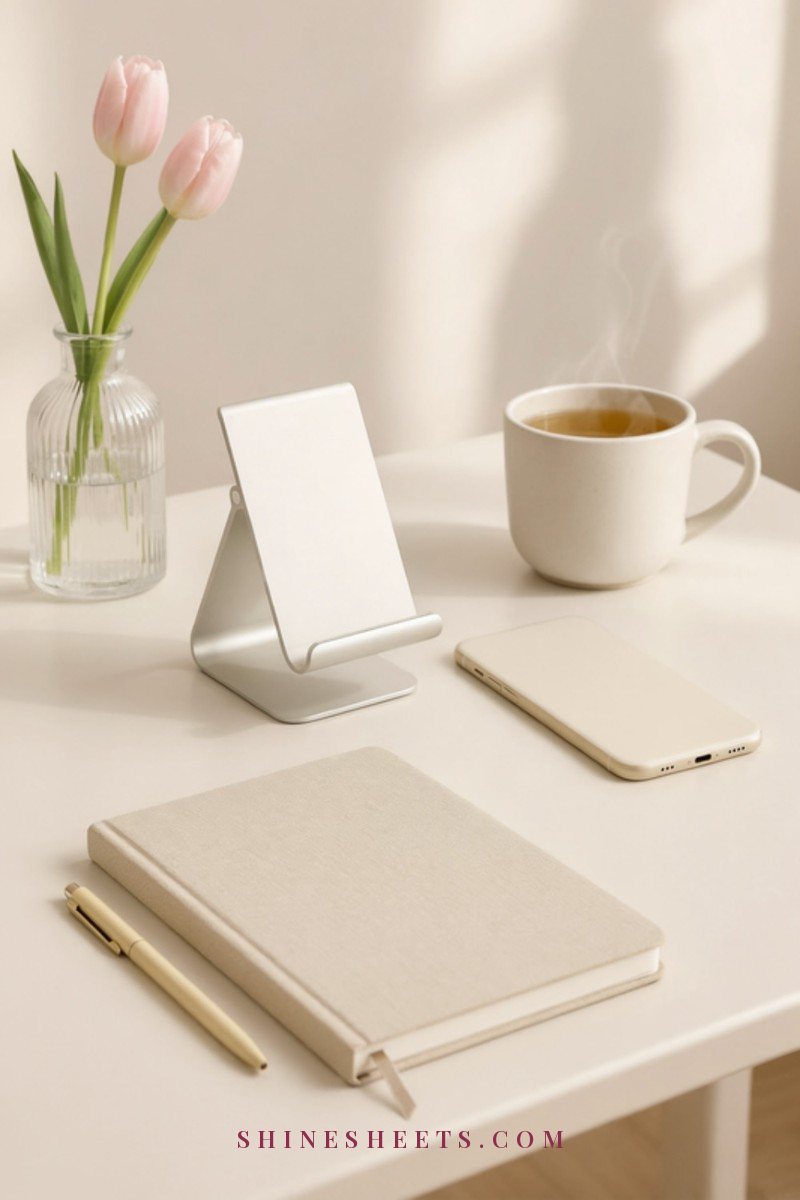
Constant checking keeps the anxious loop running. Try choosing set windows instead – for example, at the top of each hour, or at lunch and after work. Between those windows, the phone lives somewhere else: face down across the room, in a drawer, or on a white phone stand with a timer so you can see time passing without seeing the screen.
Start small. Even a 45-minute window during an evening is a real win. It will feel uncomfortable the first few times, and then, slowly, it will feel like relief.
4. Skip the Group-Chat Decoding
Sending screenshots to friends for a verdict feels supportive, and sometimes it is. But it usually turns one message into a committee meeting, and every friend brings their own history and guesses. You end up with five theories instead of one calm answer, and none of them come from him.
If you need support, try sharing the feeling instead of the screenshot: "I'm feeling anxious about how things are going, can I talk it through?" Your friends can comfort you without becoming text interpreters.
5. Reply as Yourself
Forget the rules about waiting three hours or matching his message length. Strategic texting keeps you in your head and makes the connection feel like a performance. Reply when it's convenient for you, in your own words, with your own emojis if you love them.
Honest, natural texting also gives you better information. If someone isn't comfortable with the real you – your warmth, your exclamation points, your occasional long message – that's worth knowing early.
6. Ask Directly and Calmly When You're Unsure
If something genuinely feels off for more than a day or two, asking is kinder to both of you than guessing. Keep it short, warm and curious:
- "Hey, you've seemed a little quiet this week – is everything okay?"
- "I noticed I've been reading into texts a lot. Can we catch up properly this weekend?"
- "I really like talking to you. Are you a big texter, or more of a phone-call person?"
Then take his answer seriously. If he says he's just swamped, believe that unless his actions over time say otherwise. If his words and actions keep pointing in different directions, my guide to mixed signals and what to do next can help you sort it out.
7. Look at the Pattern Over Weeks, Not One Text
One text tells you almost nothing. A pattern over three or four weeks tells you a lot. Instead of asking "What did this message mean?", ask bigger, steadier questions:
- Does he make plans and follow through?
- Does he respond eventually, even if not instantly?
- Do I feel mostly calm and cared for when we're together?
- Has anything actually changed in how he treats me, or only in my anxiety?
If the answers are mostly yes, the texts are probably just texts. If the answers are mostly no, that's information too – and it came from how he shows up, not from emoji counting.
A 5-Minute Reset for When the Spiral Starts
The seven ways above work best as habits. But sometimes you need something right now, in the moment your stomach drops at a one-word reply. This short reset takes about five minutes and pulls a few of those ways together:
- Put the phone down, screen side to the table. Physically letting go of it tells your body the emergency is over.
- Breathe out longer than you breathe in. Four counts in, six counts out, five or six rounds. A longer exhale is one of the simplest ways to calm a racing nervous system.
- Write one fact and one story. Just one line each. "Fact: he wrote 'ok'. Story: he's annoyed with me."
- Ask what you'd tell a friend. If your best friend showed you this text, what would you say to her? Probably something like "He's busy, love. Go eat something." Say that to yourself.
- Choose one small next action. Make tea, reply simply if a reply is needed, or set the phone aside until your next check-in window.
You won't feel perfectly calm after five minutes, and that's not the goal. The goal is to feel calm enough to choose what you do next, instead of letting the anxiety choose for you. Most people find the spiral loses a lot of its grip once it's interrupted even once.
It also helps to notice when you're most vulnerable to spirals. For many women it's late at night, when you're tired, hungry, or alone after a long day. If that's you, consider making the evening a no-decoding zone: you can read messages, but any big interpretation waits until morning, when things almost always look gentler.
Texting Styles Differ (and Say Little About Feelings)
Some people love texting all day. Others see their phone as a tool for logistics and save real conversation for when they're together. Neither is better, and neither reliably shows how much someone cares.
A person who sends one-word replies might be deeply attentive on a date. A person who sends paragraphs might be less invested than they seem. Work stress, a demanding family week, or just a different upbringing around phones can all change texting habits without changing feelings at all.
If you're in the early, uncertain phase, my guide to navigating the talking stage without overthinking covers that period specifically. This one is about texting anxiety at any point – and the same truth applies throughout: texts are a thin slice of a person.
When To Talk in Person

Texting is great for "running late" and "thinking of you". It's not great for anything that carries real emotion. Move the conversation to a call or face-to-face when:
- You notice yourself drafting a message longer than a few lines about the relationship.
- You want to talk about feeling hurt, confused or insecure.
- A misunderstanding has already gone back and forth more than twice.
- You're making a decision that matters – exclusivity, moving forward, or stepping back.
A simple line works: "I'd love to talk about this properly rather than over text. Are you free for a call tonight?" Voices soften things that typed words make sharp. And if the deeper feeling is a general sense of not being safe in the relationship, my article on feeling insecure in a relationship might help you name what's going on.
One gentle note: if a partner uses silence, constant monitoring or threats to control you, that's not a texting problem. Please reach out to someone you trust or a local support service for help.
Calming the Anxiety Underneath

Overthinking texts is often a symptom of a nervous system that's already running a little hot. Calming that baseline makes every message easier to read. A few small habits help:
- Have a soothing ritual for waiting moments. Pull on a soft knit cardigan, make a cup from an herbal tea sampler, and give yourself ten quiet minutes away from the screen.
- Watch your caffeine on anxious days. Coffee sometimes perks me up and sometimes makes me jittery and suspicious of every silence. On wobbly days, I switch to tea after the first cup.
- Light a candle as a phone-off signal. A cream glass jar candle on the nightstand can mark the start of your no-checking evening window.
- Breathe slower than you think you need to. Four counts in, six counts out, for one minute, before you open the thread.
I'm prone to anxiety myself, and the honest truth is that it doesn't vanish completely – it just gets quieter and easier to work with. If texting worry or relationship anxiety is affecting your sleep, work or daily life, a therapist can help you understand where it comes from and practice new responses. That's a strong, caring choice, not a last resort.
Final Thoughts
Overthinking texts doesn't mean you care too much. It means you care, and your mind is trying to protect you with very little information. Give it more helpful tools – facts on paper, a little time, a phone that rests across the room, and the courage to ask kindly when you need to.
The right connection won't hinge on a single message. You're allowed to put the phone down, breathe, and trust that what's real will still be there after your tea.